The storm passed, you walked the yard, nothing in the grass, and the roof looks fine from the driveway. Here is the uncomfortable part: shingles that lifted in the gusts and settled back flat can be completely unsealed and still look untouched from the ground.
So, do they stick back down on their own? In most cases, no. Wind-lifted shingles do not reseal themselves. The factory adhesive is engineered to bond one time, and once wind peels that bond apart, especially on a roof more than 4 or 5 years old, it will not rebond without help.
There are exceptions, and they are narrow. A shingle can occasionally reseal if it is nearly new and still pliable, the sealant strip stayed clean while it was lifted, and the roof gets several days of hot, direct sun afterward. Miss any one of those three conditions and that shingle is loose until someone seals it by hand.
How the Seal Strip Works (and Why It Only Bonds Once)
Every asphalt shingle leaves the factory with a line of thermally activated asphalt sealant on it. After installation, the sun heats the roof surface, the sealant softens, and each shingle glues itself to the course below. That bond is what turns thousands of individual shingles into one continuous, locked-down surface. It is also the single biggest part of a shingle’s wind rating.
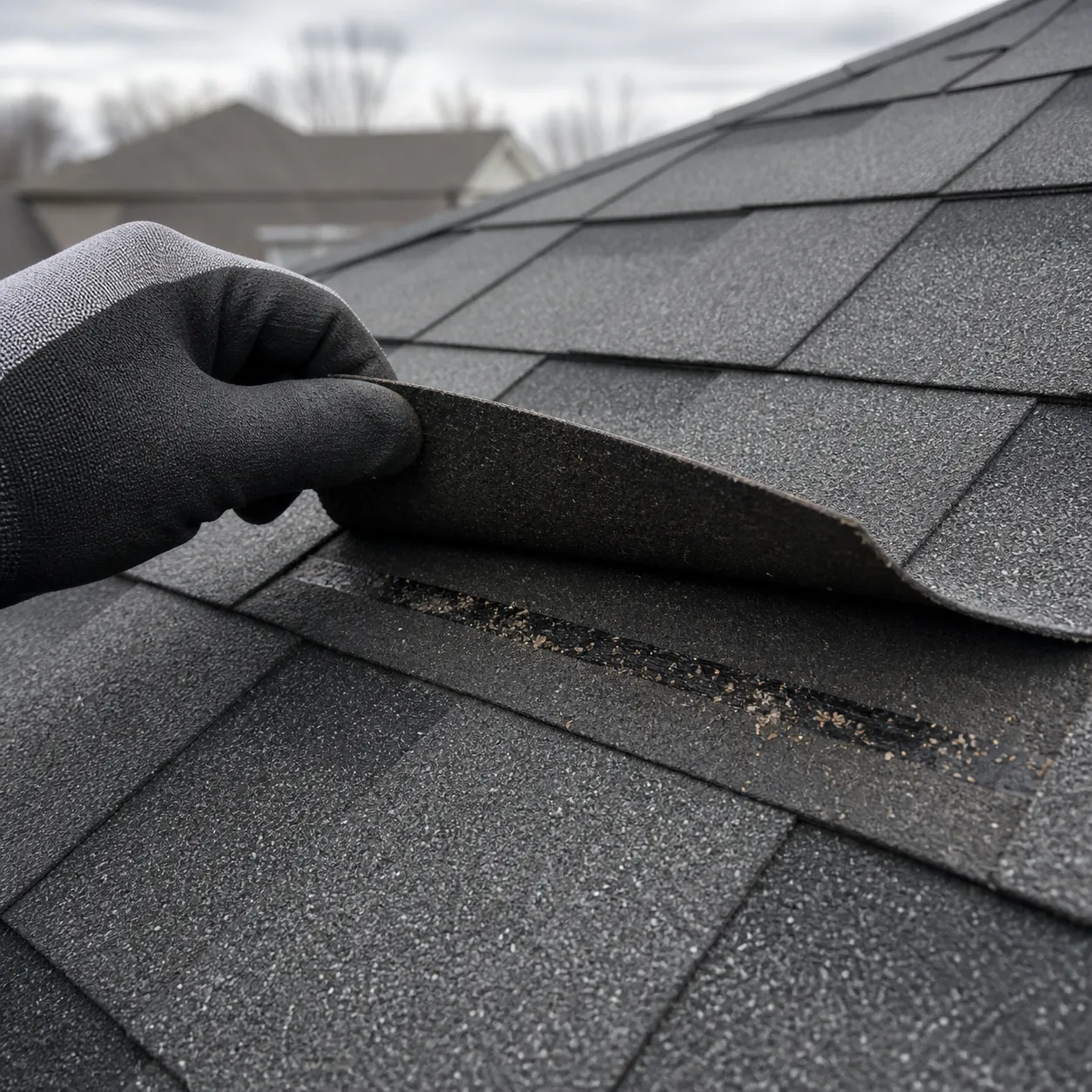
The design intent is one bond, formed once, held for the life of the roof. When a gust gets under the leading edge and pries the shingle up, the sealant does not stretch and snap back like a rubber band. It tears, the same way tape tears away from drywall. And while the shingle is standing up in the wind, dust, pollen, and grit blow onto the exposed adhesive. When the gust passes and the shingle drops back into place, it is now resting on a dirty, torn strip that has very little tack left.
Northeast Ohio adds a timing problem on top of that. Sealant needs sustained warm sun to get soft again, which around Stark and Summit County means roughly May through September. A shingle that unsealed in an October or November gale sits loose through an entire winter of freeze-thaw cycles and lake-effect wind. If you heard flapping up there after a fall storm, getting a roof repair crew out in Canton to hand-seal those shingles before the cold locks in is one of the cheapest fixes in roofing. Waiting until spring is how a $300 visit turns into cracked shingle mats and a stained ceiling.
Shingles Stay Sealed for About 5 Years. Then the Odds Turn.
This is not just our opinion from ladders. University of Florida researchers studied unsealing on real roofs in work funded by the Department of Homeland Security through Oak Ridge National Laboratory, and their finding was blunt: shingles tend to stay reliably sealed for the first 4 to 5 years of service, and after that the rate of unsealing climbs year over year. On 70 percent of the roofs they surveyed, unsealed shingles showed up in distinct patterns, meaning the sealant was failing systematically with age, not randomly.
Our field experience matches that curve. This past April, a homeowner in North Canton called us about a ticking, flapping sound on windy nights. From the street, his 11-year-old roof looked flawless. Not one shingle missing. Our crew walked it and found 43 unsealed shingles along the west rake and upper field, right where gusts recorded near 60 mph at Akron-Canton Airport had loaded the roof edge. Six of them had creased. We replaced those six, hand-sealed the rest, and the whole visit took under three hours. Had he ignored the noise, the next storm would have started tearing shingles off a roof that “looked fine.”
The takeaway: on a roof past its fifth birthday, assume wind that was strong enough to lift shingles was strong enough to unseal them permanently.
Why You Can’t See It From the Driveway
A lifted shingle that settled back down lies flat. Flat looks normal. That is the whole problem.
A few things do give it away, if you know where to look:
- Shadow lines at low sun. If a course stayed slightly raised, early morning or evening light throws a long horizontal shadow across the slope.
- Noise in wind. Ticking, slapping, or fluttering sounds on a gusty night are unsealed shingles talking to you.
- Location. Wind pressure is highest at the edges of a roof: eaves, rakes, hips, and ridges. Unsealed shingles cluster there long before the middle of a slope.
- The one-finger test. A sealed shingle resists a gentle upward pull at its bottom edge. An unsealed one lifts freely, like a page in a book. This is a check for a roofer on the roof, not something to try yourself. Aged shingles crack underfoot, and one loose granule under a shoe on a 8/12 pitch will end your week.
One more reason not to wait: unsealed shingles fail as a group. Once a single shingle is loose, wind gets under it at much lower speeds and it works like a lever on its neighbors, popping seal after seal down the course. Roofers call it zippering, and it is why one flapping shingle becomes a bare patch of underlayment two storms later.
When the Adjuster Says “That’s Not Wind Damage”
Here is the part almost nobody explains to homeowners. Many insurance adjusters are trained on an engineering doctrine that says an unsealed shingle without a visible crease, tear, or fold is not evidence of wind damage. Under that standard, a whole slope of shingles you can lift with one finger can get written off as “wear and tear.”
Forensic investigators have pushed back hard on that doctrine, and the argument is worth understanding. When wind folds a shingle back, the first crease tends to form up near the nail line, underneath the overlapping shingle above it, hidden from anyone looking down at the roof. In other words, “I don’t see a crease” is not the same as “there is no crease.” Engineers are still fighting this out in trade journals and courtrooms.
You do not need to win that debate. You need documentation. Photograph the roof and yard right after the storm with the date visible in your phone’s metadata, save any shingle pieces you find, and get an independent roof inspection before you accept a denial on shingles that lift freely. We put every broken seal and hidden crease on camera, and we will meet the adjuster on the roof and point to each one. If wind damage and the claim process is the stage you are at, our guide on spotting wind damage and handling the insurance claim walks through the whole thing.
The Right Fix (and the Lazy One to Watch For)
The repair itself is refreshingly simple, which is exactly why it gets botched by volume-chasing storm crews.
- Unsealed but not creased: hand-seal it. A quarter-sized dab of asphalt roofing cement goes under each lifted tab, then the shingle gets pressed down flat. Done correctly, a hand-sealed shingle holds as well as the factory bond. Too much cement is actually a defect, trapped solvent blisters the shingle in summer heat, so “more glue” is not better work.
- Creased, folded, or torn: replace it. A crease means the fiberglass mat inside the shingle cracked. That shingle has permanently lost its strength and its waterproofing, and no amount of cement fixes a broken mat. Watch out for the roofer who smears tar over a creased shingle, presses it flat, and calls it repaired. You just paid for a leak on a delay timer.
Our team at HOF Roofing & Construction has completed more than 1,500 roof repairs across Stark and Summit County since 2020, and hand-sealing wind-lifted shingles is one of the most common calls we run every spring and fall. Every repair is backed by our 10-year transferable workmanship warranty, and the inspection that tells you what you actually need is free.
The Week After a Windstorm: A Short Checklist
- Walk the yard and photograph everything. Shingle pieces, granule piles below downspouts, bent gutter or flashing metal. Dated photos cost nothing and win claims.
- Scan the roof edges at low sun. Look for raised courses and shadow lines along rakes, eaves, and the ridge.
- Listen on the next windy night. Flapping or ticking from the roof means broken seals, full stop.
- Book an inspection if your roof is past 5 years old and gusts topped about 50 mph. That combination unseals shingles routinely, and the damage will not announce itself until the next storm.
Common Questions About Wind-Lifted Shingles
How strong does wind need to be to lift shingles? Gusts in the 50 to 70 mph range break seals on aging shingles regularly, and that is ordinary thunderstorm wind in Northeast Ohio. New shingles carry higher ratings, some to 110 or 130 mph, but those numbers come from lab tests on fresh, perfectly installed material. A 10-year-old seal does not have lab-test strength.
Will my shingles reseal in summer heat? Only if the shingle is still pliable and the strip stayed clean, which is rare. Heat cannot rebond an adhesive that is torn and coated in dust. If a shingle still lifts freely after a week of 85-degree sun, it is not going to reseal. Ever.
Can I hand-seal shingles myself? On a low-slope ranch with a sturdy ladder, a careful homeowner can do it. The risks are the fall, cracking brittle shingles underfoot, and over-applying cement. Given that our inspection is free and a hand-sealing visit starts around $300, most people conclude the ladder math does not favor DIY.
Does homeowners insurance cover unsealed shingles? Wind is a covered peril on standard Ohio policies, but unsealed shingles are one of the most commonly disputed forms of wind damage because they are easy to dismiss without a close inspection. Documentation decides these claims. Photograph early, and have a roofer inspect before you accept “wear and tear” as the answer.