
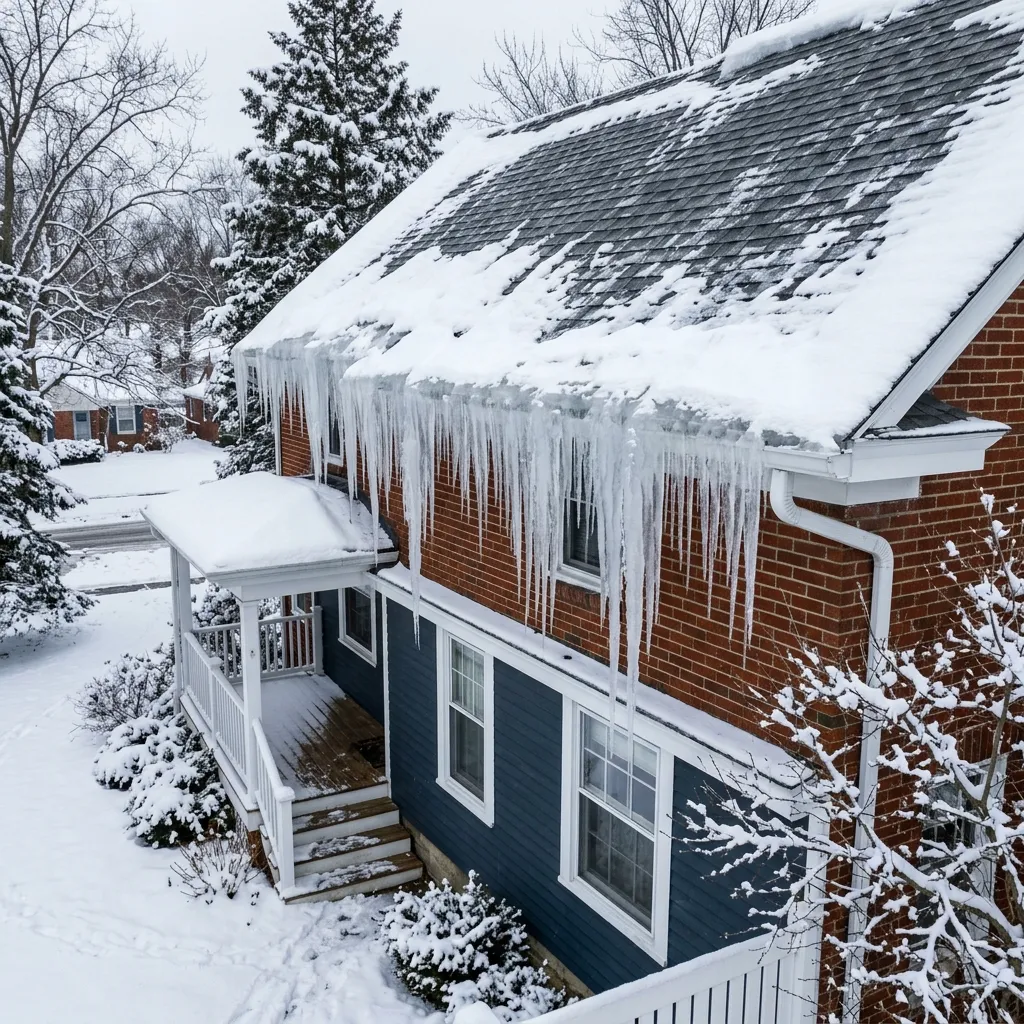
A thick ridge of ice along the edge of your roof is not just a winter nuisance, it is a dam holding a pool of meltwater that gets pushed back up under your shingles and into your ceiling. Northeast Ohio is prime ice dam country: lake-effect snow piles up on the roof, then our temperatures swing above and below freezing for days, melting and refreezing the same snow over and over.
To prevent ice dams, you have to keep your roof deck cold, which means combining balanced attic ventilation (soffit intake vents and ridge exhaust vents) with thick attic floor insulation so house heat never reaches the snow on the roof. When the whole roof surface stays at outdoor temperature, the snow does not melt prematurely and refreeze at the eaves, and the cycle that builds the ice dam never starts.
The Physics of an Ice Dam
The most important thing to understand is that ice dams do not start at the edge of your roof. They start in your attic. Here is the chain of events:
- Heat escapes. Warm air from your living space leaks up into the attic through unsealed gaps, recessed lights, the attic hatch, and thin insulation.
- Snow melts from below. That trapped heat warms the plywood deck, which melts the underside of the snowpack sitting on the shingles.
- Water runs down. The meltwater trickles down the slope, underneath the blanket of snow, toward the edge.
- Water refreezes at the eaves. The eaves and overhang extend past your heated walls, so the deck there is cold. When the meltwater reaches that cold zone, it refreezes into a growing ridge of ice.
- Water backs up. More snow melts, the meltwater pools behind the ice ridge, and with nowhere to drain it works its way up under the shingles, through the nail holes, and into your ceiling.
Notice that the shingles are not the problem in that story. The warm attic is. That is why chasing ice dams with a roof patch never works.
It’s a House Problem, Not a Roof Problem
Most homeowners call about ice dams thinking they need roof work, and a contractor looking for a quick sale will happily sell them sealant. The honest diagnosis is almost always ventilation and insulation. If you have spent winters knocking icicles off your gutters and still get leaks, a Canton roofer who will check the attic, not just the shingles can tell you whether you have a true roof leak or a ventilation failure dressed up as one. Treating the wrong one wastes your money and leaves the dam to come back next January.
Solution 1: Balanced Attic Ventilation
The goal is a cold roof deck, and you get there by flushing the attic with outdoor air. A balanced system does this with two parts working together:
- Soffit intake vents under the eaves let cold outdoor air in at the low end.
- A continuous ridge vent at the peak lets warm air escape at the high end.
Cold air enters low, rises as it picks up heat, and exhausts high, a constant flush that keeps the deck near outdoor temperature. “Balanced” is the key word: intake and exhaust need to be roughly matched in net free area. A common failure we find is ridge vents installed with no working soffit intake, or soffit vents buried under insulation so no air can actually get in. We use insulation baffles at the eaves to keep that intake path open.
Solution 2: Air-Seal and Insulate
Ventilation flushes out the heat that gets into the attic. Insulation and air-sealing stop it from getting there in the first place, and that is the more powerful lever.
- Air-seal first. Before adding insulation, seal the leaks that let warm, moist house air into the attic: the attic hatch, recessed light cans, plumbing and wiring penetrations, and the top plates of interior walls. Insulation alone does not stop air movement.
- Then insulate to depth. In Northeast Ohio we recommend insulating the attic floor to an R-49 to R-60 value. That keeps your heat in the house where you are paying for it, lowers your winter bills, and keeps the roof deck cold.
Solution 3: Ice-and-Water Shield (Your Backstop)
Ventilation and insulation prevent the dam from forming. An ice-and-water shield protects you when an extreme stretch of weather overwhelms everything else. It is a self-adhering rubberized membrane installed under the shingles along the eaves and in the valleys during a roof replacement. The membrane seals tightly around every roofing nail, so even if an ice dam forms and water backs up behind it, that water cannot reach the wood deck or your ceiling.
Building code requires this membrane along the eaves, and on homes prone to heavy snow drifting we run it well up the slope, typically at least six feet up from the eave line, for extra coverage. This is one of those details that costs a little more during a replacement and saves a lot the first time a January thaw backs water up your roof.
What Not to Do
A few common “fixes” range from useless to harmful:
- Do not chip or hammer the ice off. You will gouge and tear the shingles and create the very leak you are trying to prevent.
- Do not rely on heat cables alone. The zigzag cables along the eaves are a band-aid, not a cure. They can melt a channel through an existing dam, but they do nothing about the warm attic that caused it, and they add to your electric bill.
- Do not ignore it. A dam that leaks once will leak worse next time as the rotted decking and soaked insulation make everything colder and wetter.
If You Already Have an Ice Dam
If water is actively coming in right now, the safest move is to clear the snow off the lower few feet of the roof with a roof rake from the ground (never get on an icy roof) to remove the fuel for the dam, and put towels or a tub under the interior drip to limit damage. Then get a professional to find the real cause once the weather breaks. The long-term fix is always ventilation, insulation, and proper membrane, not another winter of chipping ice.
Common Questions About Ice Dams
Do roof rakes actually help with ice dams? Yes, as a stopgap. Raking the snow off the lower edge of the roof from the ground removes the snow that feeds the dam. It does not fix the underlying warm-attic cause, so treat it as first aid, not a cure.
Are heat cables worth installing? They can keep a drainage channel open on a problem roof, but they treat the symptom and use electricity to do it. We would rather fix the ventilation and insulation so you do not need them.
Will adding more attic insulation alone stop ice dams? It helps a lot, but only if you also air-seal the ceiling and have working ventilation. Piling insulation over leaky penetrations and blocked soffit vents does not solve the problem.
Does an ice-and-water shield mean I will never get an ice dam? No. The shield is a backstop that keeps a dam from leaking into your home, but you can still get ice buildup at the eaves. The way to actually stop dams from forming is the cold-roof combination of ventilation and insulation.