
A single leaking gutter seam can pour hundreds of gallons of water straight down against your foundation during one good Ohio thunderstorm. Gutters have one job, to move roof runoff away from the house, and when they leak they do the opposite. The water rots your fascia and soffit, saturates the soil at your footer, and eventually finds its way into your basement.
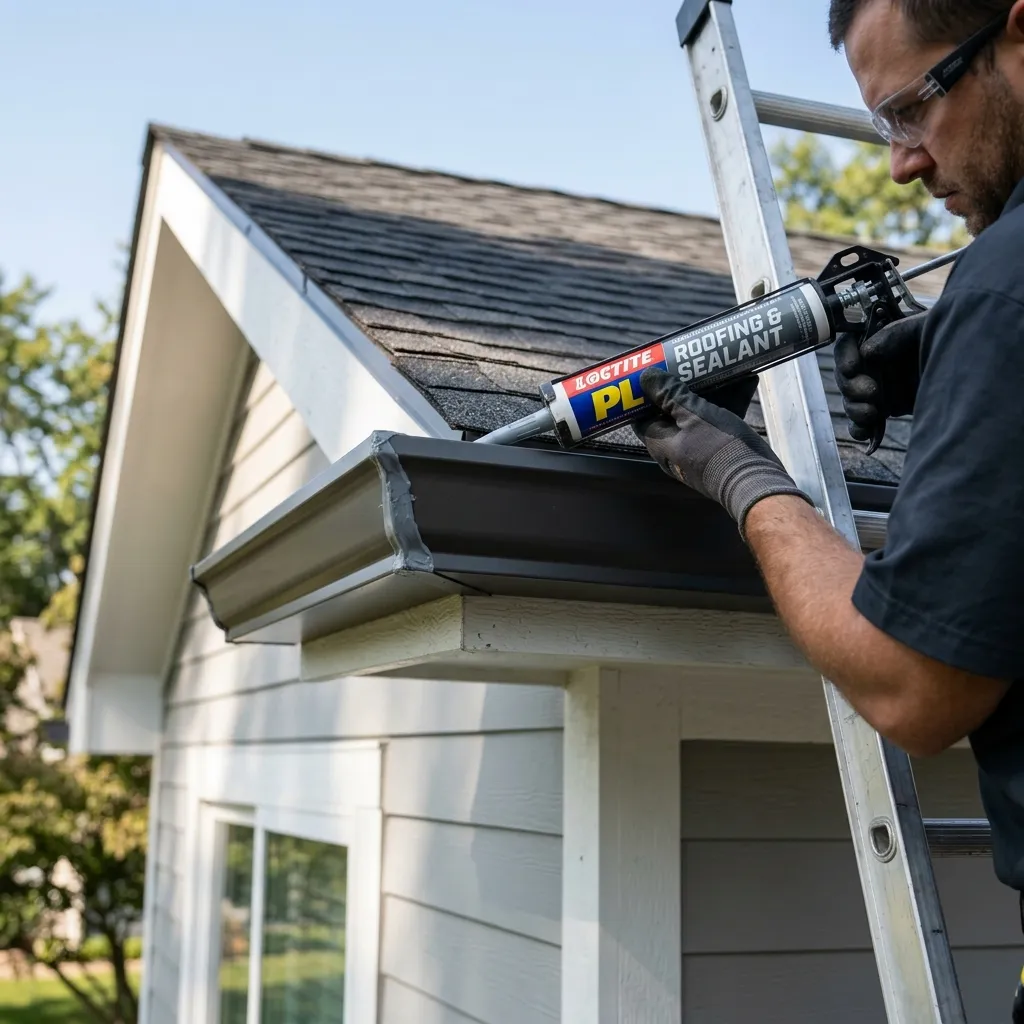
To fix a leaking gutter, clean and fully dry the leaking joint, scrape off the old failed sealant, and lay a thick bead of butyl rubber or tripolymer gutter sealant over the inside of the seam. That creates a flexible, watertight bond that can expand and contract through Ohio’s freeze-thaw swings without cracking. The catch is that you have to seal the right spot, and most homeowners seal the wrong one.
First, Find Where It Is Actually Leaking
Gutters rarely leak through the middle of a run. They leak at the joints, the places where two pieces of metal meet. Before you touch a tube of sealant, walk the gutters during a rain (or run a hose into them) and watch for drips at these spots:
- Seams: Anywhere two sections of sectional gutter are joined. This is the most common failure point on older gutters.
- Corner miters: The 90-degree corners are stressed constantly and the factory sealant there fails early.
- End caps: The small caps that close off the ends of a run almost always start dripping first.
- Downspout outlets: Where the gutter drops into the downspout, the seam around the outlet tube loosens and leaks.
- Behind the gutter: If water runs behind the gutter and down the fascia, the problem is usually a missing or bent drip edge at the roof’s edge, not the gutter at all.
Knowing which of these is leaking tells you whether you have a five-minute sealant job or a bigger drainage problem.
Step 1: Clean the Joint Down to Bare Metal
Sealant sticks to clean metal, not to wet grit and old caulk. Skip this step and your repair fails within a week.
- Scoop it out: Remove every leaf, twig, and bit of roof grit from the area around the joint.
- Scrape the old sealant: Use a putty knife or wire brush to strip off the cracked, peeling silicone or caulk that is already there.
- Degrease and scrub: Wash the metal with soapy water, then wipe it down with rubbing alcohol to cut any grease or oxidation.
- Dry it completely: Let the sun do it or towel it dry. Any moisture trapped under the bead will break the bond.
Routine debris is the root of most gutter failures, and to be straight with you, we do not take on gutter cleaning as a standalone service. If your real concern is that overflowing gutters are backing water up under your shingles and into the house, that is a roofing problem, and a Canton roof repair visit will tell you whether the water damage stops at the fascia or has already reached your decking.
Step 2: Use the Right Sealant (Not Bathroom Caulk)
This is where people go wrong. Standard household silicone or painter’s caulk cannot survive standing water and the brutal expansion and contraction a metal gutter goes through between a 95-degree July roof and a 5-degree January morning. It gets brittle, lets go, and you are back on the ladder by next season.
Use a sealant made specifically for gutters: a butyl rubber sealant or a tripolymer gutter sealant. Load the tube, cut the nozzle at a 45-degree angle, and run a generous bead over the seam on the inside of the gutter, where the water sits. Tool it smooth with a gloved finger so it fully covers both edges of the joint. Inside, not outside, is what matters, because that is the side holding water.
Step 3: Fix Sagging Gutters and Bad Pitch
Sometimes the joint is fine and the gutter is simply sagging. When a section droops, water pools in the low spot instead of draining, then overflows the front edge and overworks every seam until they leak too.
The usual culprit is old gutter spikes, the long nails that pull loose from the wood fascia over years of freeze-thaw and expansion. Pull those and replace them with hidden gutter hangers, screws that thread into the rafter tails behind the fascia every two feet or so. This pulls the gutter tight to the house and lets you reset the correct slope, about a quarter inch of fall for every ten feet of run, toward the downspouts.
Why Leaking Gutters Are a Roof and Foundation Problem
Homeowners treat gutters as an afterthought, but a failing gutter system attacks the most expensive parts of the house. Water spilling behind the gutter rots the fascia board and the soffit, then works back into the roof decking at the eave. Water dumping at the foundation erodes the soil, saturates the footer, and shows up as a wet basement or cracked block. Over a few winters, a $20 sealant problem you ignored turns into rotted trim, a soggy crawlspace, and foundation repair quotes with a lot more zeros.
Seal It or Replace It?
Sealing is the right call when the gutters are sound and a joint or two has simply aged out. Replacement is the honest answer when:
- The metal is rusted through or riddled with pinholes.
- The gutters are pulling away from fascia that is already soft and rotted.
- Multiple seams leak at once, which means the whole sectional system is at the end of its life.
- The system is more than about twenty years old.
Modern seamless aluminum gutters are roll-formed to length on-site in one continuous piece, so the only joints are at the corners and downspouts. No seams across the runs means the leaks that plague old sectional gutters never get a chance to start. If you are already replacing your roof, doing the gutters at the same time is the most efficient way to make sure the whole edge of your home sheds water the way it should.
Common Questions About Leaking Gutters
How long does gutter sealant last? A quality butyl or tripolymer sealant applied to clean, dry metal will typically hold for several years. Cheap silicone caulk on a dirty joint can fail in a single Ohio winter.
Why does my gutter leak only in heavy rain? That usually is not a seam leak at all. It is overflow, the gutter or downspout is undersized or clogged, so water sheets over the front edge during a downpour. The fix is cleaning, larger gutters, or more downspouts, not sealant.
Are gutter guards worth it? They cut down on cleaning and clogging, which matters most under heavy tree cover. They are not a cure-all, fine grit and shingle granules still get through, so the system still needs occasional attention.
Can leaking gutters really damage my foundation? Yes, and it is the most expensive consequence. Water repeatedly dumped at the base of the house saturates and shifts the soil that supports your footer, which leads to settling, cracks, and basement water intrusion.